Tomorrow I'm off to the French Alps for a few weeks with a strong team and a big objective - suffice to say despite my recent sport climbing I'll be mainly on photo detail! I'm not expecting any access to a computer, but if I can I'll try to post an update before we get back - lack of RAW editing facility, rather than the internet, is likely to be the stopper, but I'll go for text only if so.
We're travelling out by car so I've got the luxury of packing a good choice of kit, the Mamiya 645 will be in but I doubt it will make it onto the mountain. I've not shot digital on a multi-day mountain trip before (although I went digital three years back now, on the Lotus Flower trip we were looking at twelve days between plug sockets, so I went back to my old OM kit) so it'll be interesting to see what I end up cutting back to and what works best.
Monday, 3 August 2009

Saturday, 18 July 2009
Summer

High summer in The White Peak, and its a relief that after the dire summers of the last two years the wildlife seems none the worse for wear. In my, admittedly limited, experience it seems insect colonies that were down to low levels last summer have bounced back impressively, with birds and plants are doing well too. The weather this year has been a succession of hot, dry spells interspersed with wet, cold periods, rather than the mild but dull and very wet summers of the last two years, or the hot and dry of previous years. Looking at temperature graphs for the last few hundred years, it looks like the ragged sawtooth's interminable rise might be in a regressive pattern for the next decade. This winter was certainly a little more like 'winters used to be', and the wildlife seems to be benefiting. Of course the concern is what happens after our brief reprieve period...
I've been experimenting a little with white background work to produce some design-ready nature images. There's a fair degree of faff and extra equipment required, but the resultant images ceratinly have their uses. Here's a comparison of The Peak's two native Orchids of the genus Epipactis - the Dark-red and Broad-leaved Helleborines.

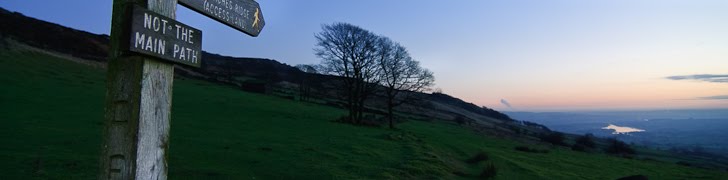
Traditionally this is regarded as a difficult time of year for the landscape photographer, with the sun high in the sky for much of the day, throwing harsh blue light onto a predominantly green landscape. Although I tend to be immersed in nature photography at this time of year, The Peak has more to offer than many landscapes in summer. Drifts of Cottongrass already add shimmering silver strips to the moors, whilst Bell Heather is just coming into flower on south-facing slopes. Pretty soon it'll be joined by the more widespead Ling and the moors will be at their most spectacular. Its not all uniform green in the White Peak either. Haymaking breaks the fields into a patchworks of yellow and green as early as May, and carries on 'til late July when the most ecologically important fields, under stewardship schemes, are left to seed before mowing. Autumn's colour might seem a way off yet, but the straw yellow of drying grasses are caused by the same process and can be just as photogenic. My favourite landscape photo of the last month has been up on Kinder. Mindful of the fact I'll be away for the peak of the Heather season this year, I teamed up with my boy Cofe for an evening shoot on the western edge of the plateau.

Tuesday, 7 July 2009
Sketches
Lots of little things have gone on since my last post. Nothing big, but no lack of interest either. We had a week in the Outer Hebrides at the start of June, which didn't disappoint. Despite taking a car-full of camera gear, I really got into using my Ricoh compact on this trip.

A lot of the time I was sketching with a view to returning with more serious gear if the weather cooperated, but having seen the quality it can produce it also meant I could my binos round my neck, D300 + 300mm over my shoulder, Ricoh in pocket and be ready for landscapes or wildlife without needing a bag.

Getting back to The Peak, I've kept using it for sketching out locations in marginal weather. Attempts to return for a proper go haven't always worked, what with the weather, the midges, and the fact that when you get down to it, it can be damn near impossible to improve on a photo, even when its one of your own. There are a lot of subtle factors which you rarely take into account as being crucial when deconstructing photos, so its always instructional to try and repeat a shot. If nothing else it'll give you an appreciation of how much the landscape changes in a week or so.
Climbing-wise, I've surprised myself in getting into limestone more than ever, and bolted lime at that! The motivation is easy; in a few weeks I'm off to Mont Blanc's Grand Capucin with a strong team, and I need to get fitter. I've done a lot of trad lime, and enjoyed it all, but the combination of uncomfortable holds, uninspiring lines and arbitrary bolting of Peak sport has always seemed a particularly joyless challenge. I can trace part of this change in attitude back to a conversation I had with Pat Littlejohn whilst taking a minibus of foreigners down to Craig Dorys. Discussing some of the piles of choss he'd climbed over the years, he explained that he has never viewed poor rock as a detrimental quality, but just simply as a fact of the route. It can add to the character, or it can detract, but in itself it just is. Whether, to a climber, it is a problem, is something foisted on it entirely by the climber's preconceived notions of quality.

I really liked this philosophy, and it ties in well with the zen approach I mentioned in an earlier post. I've never had a problem viewing loose rock as interest, so on the Peak lime this year I've been trying to put notions of good and bad out of my head, and simply see what there is to learn. I always like learning, and along with the dose of variety its enough to keep me happy. So far it seems to be working; I managed to actually work a route over several sessions at a grade harder than I've done before (a lowly 7c) and, when it came to it, got a lot of satisfaction from the redpoint. I was surprised to find it really does feel easier (and a lot better!) when you do it. Now if I could just get my head round working stuff a bit better...

A lot of the time I was sketching with a view to returning with more serious gear if the weather cooperated, but having seen the quality it can produce it also meant I could my binos round my neck, D300 + 300mm over my shoulder, Ricoh in pocket and be ready for landscapes or wildlife without needing a bag.

Getting back to The Peak, I've kept using it for sketching out locations in marginal weather. Attempts to return for a proper go haven't always worked, what with the weather, the midges, and the fact that when you get down to it, it can be damn near impossible to improve on a photo, even when its one of your own. There are a lot of subtle factors which you rarely take into account as being crucial when deconstructing photos, so its always instructional to try and repeat a shot. If nothing else it'll give you an appreciation of how much the landscape changes in a week or so.

Climbing-wise, I've surprised myself in getting into limestone more than ever, and bolted lime at that! The motivation is easy; in a few weeks I'm off to Mont Blanc's Grand Capucin with a strong team, and I need to get fitter. I've done a lot of trad lime, and enjoyed it all, but the combination of uncomfortable holds, uninspiring lines and arbitrary bolting of Peak sport has always seemed a particularly joyless challenge. I can trace part of this change in attitude back to a conversation I had with Pat Littlejohn whilst taking a minibus of foreigners down to Craig Dorys. Discussing some of the piles of choss he'd climbed over the years, he explained that he has never viewed poor rock as a detrimental quality, but just simply as a fact of the route. It can add to the character, or it can detract, but in itself it just is. Whether, to a climber, it is a problem, is something foisted on it entirely by the climber's preconceived notions of quality.

I really liked this philosophy, and it ties in well with the zen approach I mentioned in an earlier post. I've never had a problem viewing loose rock as interest, so on the Peak lime this year I've been trying to put notions of good and bad out of my head, and simply see what there is to learn. I always like learning, and along with the dose of variety its enough to keep me happy. So far it seems to be working; I managed to actually work a route over several sessions at a grade harder than I've done before (a lowly 7c) and, when it came to it, got a lot of satisfaction from the redpoint. I was surprised to find it really does feel easier (and a lot better!) when you do it. Now if I could just get my head round working stuff a bit better...
Wednesday, 20 May 2009
Stanage birds
One of the things I've been busy with the last few weeks is the birds at Stanage. I got involved with the BMC's access team about eighteen months or so ago after expressing a little too much interest in what was happening on the Eastern Edges. One of the main tasks is to tour Stanage and Burbage with Bill, the North Lees estate warden, looking for the Ring Ouzel nests. Ring Ouzels only live in moorland and mountain habitats, and there's some evidence that their range is contracting northwards and to higher altitudes in response to global warming. They disappeared from The Roaches some years ago, and on the Eastern Edges occur no further south than Burbage.

Bill does the bulk of the work finding the nests in the early mornings and late evenings, then once he has a good idea of their locations we go out and decide whether a restriction on climbing is needed. My trainer-soloing skills are occasionally required for checking the innaccessible nests with minimum disturbance, but my presence is more to advise on the popularity of any adjacent climbs, and hence the size of any restriction. Despite the high profile of the Popular end restrictions they are actually rarely used. So far this year we've had 7 nests on Stanage with only two restricted areas, both covering the same pair. As soon as the chicks fledge the parents get straight on with a second brood in a new nest, the male continuing to feed the fledglings whilst the female starts incubating. That's right where we are now so its taking up quite a few of my evenings this week.
As the shot above shows, its also been a good opportunity for me to scope out some good locations for photographing the birds. Bill's knowledge has also been invaluable in going about this without disturbing the birds. Its also nice just to go out birdwatching for its own sake again, something I rarely do nowadays, although I seldom go out without pair of binos stashed in my bag. As well as the expected residents like Woodcock and Grashopper Warbler we've had Short-eared Owl, Buzzard and Raven, none of which are common on these still-keepered moors, and a real treat in a party of Dotterel at Crow Chin.

Dotterel are one of those species which, like Ring Ouzels and Chough, have a special meaning for anyone who loves high, wild places. Less than a thousand pairs nest in the Uk, and only on the highest mountain tops, the Cairngorms being a particular stronghold. They are one of the last species to migrate north come spring, and every year they break their journey north from the Atlas mountains at traditional spots like the Carneddau plateau and Pendle Hill. Its something of a pilgrimage for hillwalking naturalists to get to one of these spots at the right time (mid/ late May) and catch a glimpse of these mountaineering plovers as they head north, and one I've long intended to do. I didn't expect them to come to me; perhaps a little karma for looking after the Ouzels? This one is a female; unusually the brighter of the sexes, a role-reversal that extends to them displaying to attract a mate, who is then left to incubate the eggs and rear the young.
Friday, 8 May 2009
The Zen arcade

Climbing media nowadays is awash with increasingly sophisticated advice on training on strength and stamina. Wisdom on technique is basic by comparison, and as a result folk keen to improve often focus on the physical aspects. Part of the problem is that strength training is so easily reductible in a scientific manner whilst technique is not. So first lets try to define technique; mine is simply that technique is efficient movement.
I look at climbing not as a simple physical challenge, but as a four-dimensional puzzle. On an easy climb there are any number of solutions, but as the climb gets harder the available solutions get less in number and demand greater precision in execution. Strength can help you bulldoze through but the really useful skill is to be able to find the most efficient solution quickly and repeatedly. This is the skill I'm most bothered about in my own climbing, and what I touched on in the previous post is that I don't feel its one that has especially improved over the years. I don't agree that this is because it is innate talent, it certainly wasn't for me, but I think it is the kernel of truth behind the old adage 'the best training for climbing is climbing'.
The subtleties of sequence choice and body-positioning are best left to the subconscious, as Bruce Lee put it 'don't think - feel', and the best way to get that to learn is to immerse it in the environment you want it to perform in. Long-term training on a board is likely to leave your subconscious confused when you get back on the rock, just as a summer on lime leaves you flailing on the grit. Malcolm Gladwell's recent book Outliers glibly suggested that elite performers in any discipline have one thing in common - not talent - but practice, and at least 10,000 hours of it. In Jerry Moffatt's book Revelations he recalls training endlessly in a cave at Stoney, confident that he is the only one of his peers so motivated, and later reaps the rewards in the USA.

Back when I was twenty and obsessed I put in far more hours, all on the rock, than I do now, and I'm sure that's the key to what I seek. Of those climbers that are putting the hours in now, how many are on unrealistic artificial surfaces? I'm sure that you have to spend at least 50% of your climbing time on rock to avoid loss of technique. My base level is high enough now for me to rest on my laurels at a respectable standard, and there's also a problem of dimishing returns in seeking out new problems locally to solve, so its not likely to change soon. In fact I'm quite looking forward to decrepitude setting in and pushing me back down through the grades and a new set of puzzles!
What has also intrigued me is how technique in climbing is analagous to composition in photography. Its another four dimensional puzzle that for me gets played out twice for each photograph. First there is getting yourself to the right place at the right season, time of day and weather. Secondly is settling on the right angle of view and precise positioning to resolve the elements within the frame and give a harmonious composition. I say harmonious but its an inadequate word, for many shots you may be trying to create a startling effect or a neutral one. If its a climbing shot a lot then rests on the timing at the last instant, plus recomposing on-the-fly to ensure that as the main subject moves they aren't upsetting the composition as a whole. On a landscape shot the final timing is also suprisingly fraught, I guess the final images give the impression that the making of the image is a calm affair - not usually! The final composition has to be tweaked to accomodate moving and reshaping clouds, wandering sheep etc, all whilst trying to capture what is usually fleeting good light and ensuring any wind effects on vegetation are as desired.
I'm sure lessons learnt in reading climbs have been used to good effect in composing photographs, and I'm sure in time compositional trials will further my pursuit of a more refined climbing technique. Some of my most productive times in both areas have undoubtedly been away on trips when I've been immersed in both on a daily basis.
I equate making it to a good location with the right gear in the right season to turning up to try a climb fit, strong and with the right boots. Success of sorts may be easy to achieve, whether the desired tick or a half-decent photo, but what will create real lasting satisfaction comes down to those last little elements, and ultimately, technique. Flashing the climb with an elegant sequence, or quickly settling on a really cogent composition, these are things that cannot be trained for but rely on regular practice in the field coupled with maintaining an open, creative mindset. Or as the Zen maxim goes:
'First develop a perfect technique. Then place yourself at the mercy of inspiration.'


Subscribe to:
Posts (Atom)
